
Establish the applicable requirements
The Standards Institution of Israel lists SI 1173 Part 1 as addressing external lightning protection systems for buildings and installations, including design, execution and inspection. Its public description also identifies scope limitations and the possibility of additional requirements for high risk facilities. Those boundaries matter when interpreting what an external system can establish. [2]
Check the relevant official requirements and the applicable edition for the actual project. A standard's catalogue description is useful for identifying its subject, but it does not replace the complete text or establish every legal obligation. Do not infer a mandatory height threshold from a short web description or from a neighbouring building's installation.
International references can explain additional concepts. IEC 62305 includes material on risk management, physical damage and internal electrical and electronic systems. Current international editions do not automatically become Israeli project requirements. Record why each reference is being used and how it relates to the governing local requirements. [3][4][5]
For the archive, the opening brief should therefore identify the building location, intended use, existing protection and the professional responsible for establishing the requirements. Resolve the reference framework before asking suppliers for an apparently complete hardware quotation. Otherwise, their offers may address different scopes while appearing commercially comparable.
Build a site and service inventory
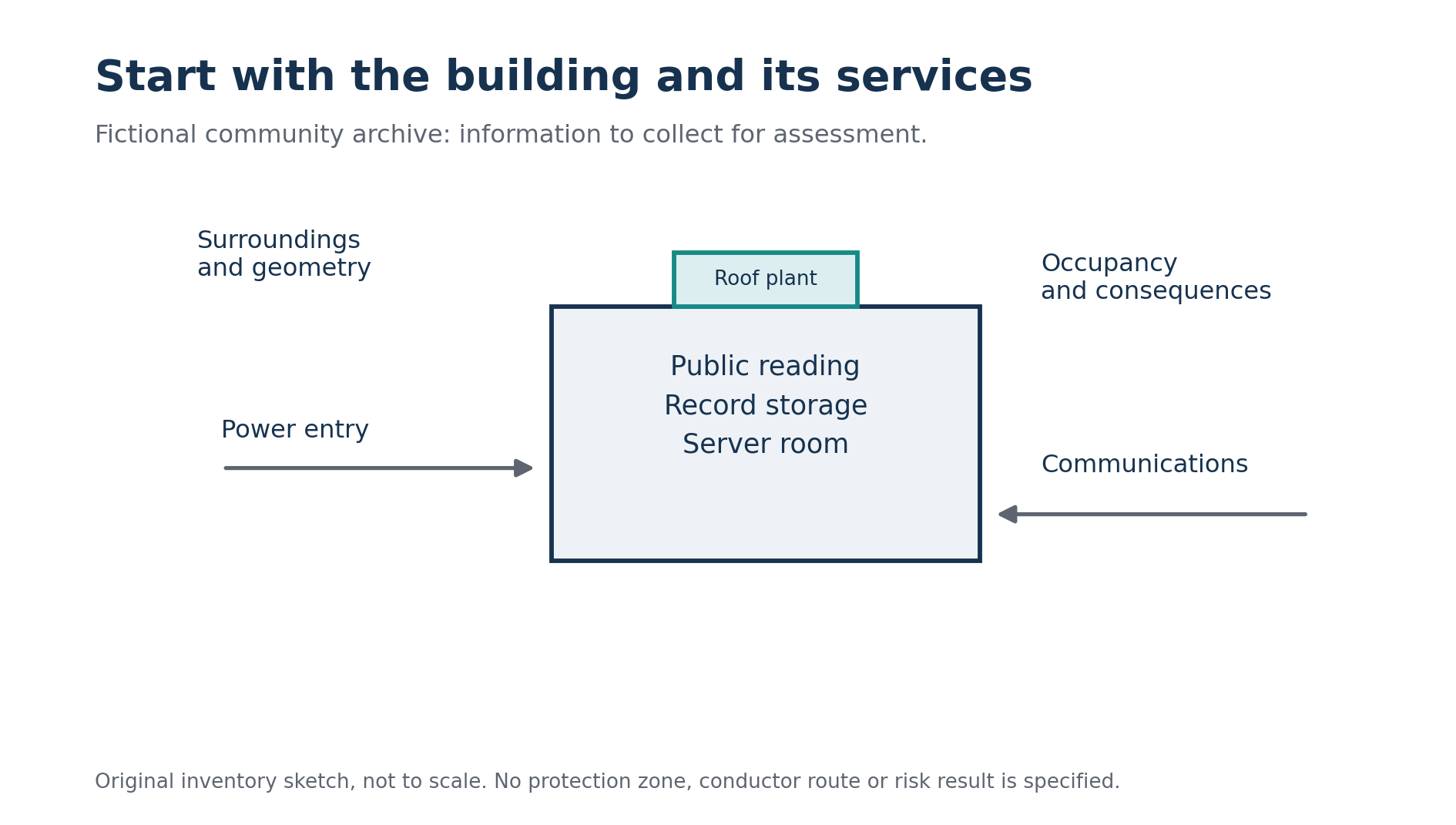
Collect the building geometry, roof arrangement, surrounding conditions and relevant construction information. Record major rooftop equipment and planned alterations. Identify whether the information comes from current drawings, a survey or an old file. An assessment based on the wrong roof layout can miss the very feature that prompted the protection question.
List incoming and outgoing services. The archive may have electrical supply, communications, alarm connections and other conductive services. Identify their routes and interfaces at an appropriate level of detail for the assessment. A proposal concerned only with the roof can overlook the systems through which damaging transients may affect equipment.
An archive assessment needs building, service and consequence information. Original inventory sketch, not a protection design.
Describe the occupied areas and the building's operating pattern. The public reading room, a restricted storage area and a rarely accessed roof involve different uses. Do not compress them into “a small building” and discard information relevant to the consequences being assessed. The professional risk method determines how those inputs are used.
Inventory the sensitive assets as well. Paper records, digital records and environmental control equipment create different consequences of failure. Identify what is replaceable, what needs continuity and what could be lost permanently. This information belongs in the assessment brief even when it does not appear on an electrical drawing.
Evaluate risk before choosing measures
IEC 62305-2 describes a risk management procedure for structures affected by lightning flashes to earth, with protection measures selected to reduce risk against the chosen tolerable criterion. Its public description establishes the purpose of the method, not a completed calculation for the archive. The actual assessment needs the applicable full method and verified inputs. [3]
Do not invent a local lightning occurrence value because an exact number makes the report look complete. Obtain suitable data and record its source, geographic basis and use in the selected method. Likewise, do not fill missing building characteristics with convenient defaults without making the assumptions visible and assessing their effect.
For the archive, compare credible consequences: injury, physical damage, loss of irreplaceable records and interruption of services. The applicable method determines the categories and calculations. The owner can help describe the practical impact, while the specialist establishes how the information enters the technical assessment.
Keep existing protective measures distinguishable from proposed measures. A report should show what was assessed initially and what changes are expected from the proposal. Otherwise, an improvement can be claimed without a clear baseline. A transparent assessment lets another reviewer understand which measure addresses which component of the problem.
Distinguish external and internal protection
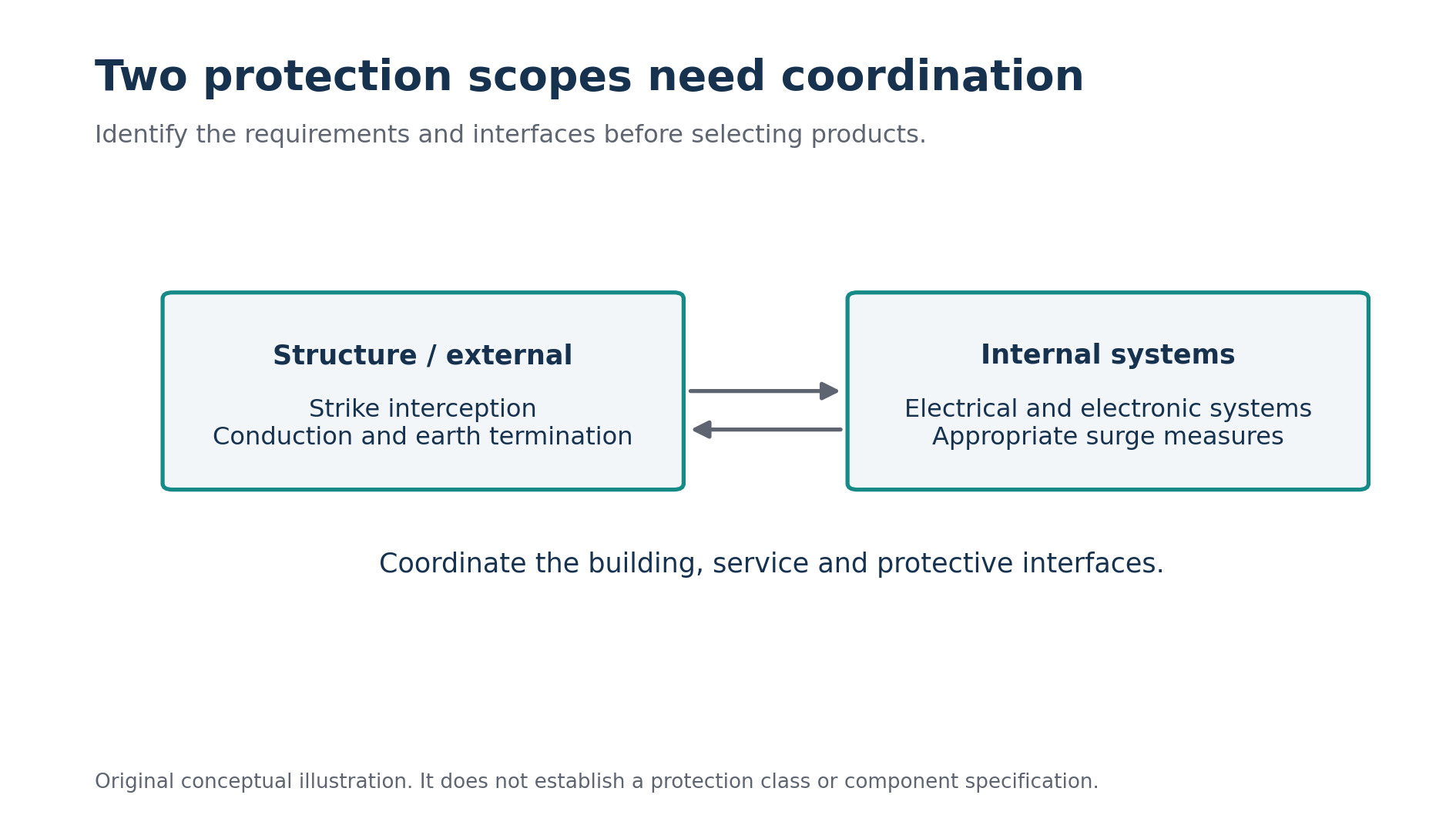
External protection concerns the structure's response to a direct lightning event through the designed system and its integration with the building. Internal protection concerns electrical and electronic systems and the relevant surge protection measures. These scopes need coordination, but a component intended for one purpose should not be described as completing the other. [4][5]
In broad terms, an external system can involve strike interception, conduction paths and an earth termination arrangement. Their design, placement, continuity and relationship to the building require specialist assessment. This conceptual description is not a construction layout and does not establish spacing, protection angles or separation distances. [6]
For the archive, ask whether the external proposal addresses the actual roof equipment and building geometry. Also ask how its installation interacts with roof maintenance and future alterations. A drawing showing one roof component without the rest of the designed system cannot support a complete assessment of external protection.
Then review the internal systems separately. The server room, alarm system and communications entry may need different interfaces examined. A roof system does not eliminate every surge concern inside the building. Equally, a surge protected power strip should not be presented as evidence that the building has an external lightning protection system.
Understand what an SPD contributes
A surge protective device limits transient overvoltage within its specified application and protection arrangement. Manufacturer guidance distinguishes SPD types and their roles within coordinated protection. Selection requires attention to the electrical system and the equipment being protected; the word “surge” on a product label is not a complete specification. [7]
For the archive, identify the power entry arrangement, distribution points and sensitive equipment before comparing products. Also identify communication or control connections that may require their own appropriate protection. Protecting one power connection does not automatically address another conductive interface serving the same equipment.
Read the product and coordination information. Relevant characteristics include suitability for the system, protection level, discharge capability and the associated protective arrangement. Installation details influence the completed protection, so a data sheet alone does not establish the performance of an assembled project. The designer and installer need the applicable manufacturer instructions and governing requirements.
Avoid promising that an SPD will keep equipment safe under every conceivable event. Its role is defined by its specification and the designed system. A realistic proposal describes the intended reduction of exposure and the remaining limitations. This explanation helps the owner make an informed decision without turning a component's marketing claim into a guarantee for the entire archive.
Coordinate the interfaces between systems
External and internal measures meet at building and service interfaces. The specialist needs to assess the relevant bonding, routing and separation questions through the applicable method. Do not improvise a separation distance from a photograph or copy a conductor arrangement from a different building with different conditions.
The archive's roof ventilation equipment provides a useful coordination example. Its metalwork, power supply and physical position may affect several parts of the assessment. The roof plan, electrical drawings and lightning protection drawings should describe the same equipment. If the ventilation unit moves, the responsible designers need to review the affected interfaces.
Photovoltaic additions create another possible revision event. A future rooftop installation can alter the geometry, conductive connections and electrical system information relevant to the existing design. Record that planned work in the brief. An earlier lightning assessment should not be assumed to cover equipment that did not exist when its inputs were established.
Assign responsibility for these interfaces clearly. A supplier may provide an external component, another contractor may install electrical protection, and a third may maintain rooftop equipment. The project still needs one coherent design and verification process. Responsibility should follow the required work rather than disappear between separate quotations.
Compare quotations by scope and evidence
Ask each supplier to identify the assessment basis, proposed system scope, equipment references, drawings, installation work and verification deliverables. A price for a roof component is not comparable with a price for an assessed external system plus coordinated internal measures. Make those differences explicit before evaluating cost.
Request the reasons behind the proposed measures. Which assessed issue does each measure address? Which requirement governs its selection? What information remains to be confirmed? These questions expose an incomplete proposal without requiring the owner to reproduce the specialist's calculations.
For the fictional archive, one offer might include a detailed roof system but exclude internal surge protection. Another might offer electrical devices but no external assessment. Both can describe useful work within their limits. Neither should be treated as a complete answer until the combined project requirements and responsibilities have been reconciled.
Preserve assumptions and exclusions in the final scope. If communication services are outside one contractor's work, assign their assessment elsewhere rather than leaving them unmentioned. If a survey is still required, explain which design decisions depend on it. A clear scope makes approval and procurement more meaningful.
Plan inspection and maintenance from the beginning
Protection systems need the applicable inspection and maintenance arrangements. Develop the plan using the governing requirements, the design and manufacturer instructions. Do not publish one universal interval for every building or assume a system remains adequate indefinitely because it was once installed.
Keep the relevant drawings, product records, assessment information and verification results available. Record changes to the roof, services and protected equipment. Maintenance personnel should be able to identify what exists and where to report a defect without reconstructing the design from photographs.
If damage or an unusual event prompts an inspection, describe the observations precisely and obtain the required professional assessment. Visible continuity of a few components cannot establish the complete system's condition. The inspection record needs to address the functions and criteria required by the applicable process.
Finish with a project brief people can use
The archive's completed brief should connect its building survey, service inventory, consequences, governing references and selected protection measures. It should explain the external scope, internal scope and their interfaces. It should also identify the verification and maintenance responsibilities that make the proposal workable after installation.
For study, practise reviewing a fictional quotation against that brief. Identify one omitted service, one unverified input and one unclear responsibility. Then explain what information would resolve each issue. This exercise develops practical judgement without inventing an assessment result or pretending that a catalogue description contains a full design method.
The owner can also improve the brief by identifying dependencies between assets. In the archive, the server may support the catalogue, while ventilation supports storage conditions and alarms support incident reporting. Losing one service can therefore affect more than its replacement cost suggests. Document these operational relationships in plain language and give them to the assessor. Keep separate records for existing safeguards such as backups and recovery arrangements, because those measures have their own functions and limitations. This practical information does not replace the technical risk method. It gives the specialist an account of what the building does and what disruption would mean for its users and records.
Lightning protection becomes clearer when the project begins with evidence. Establish the requirements, survey the structure and services, assess the relevant risk and select coordinated measures. Then preserve the design and verification records so later changes can be reviewed. The result is an understandable protection proposal whose scope matches the building and the owner's actual needs.
מקורות והפניות
המקורות המוזכרים בגוף המאמר מופיעים כאן כפי שנמסרו במקור.
- [1] Nami Academy: lightning protection assessment tool
- [2] Standards Institution of Israel: SI 1173 Part 1 catalogue scope
- [3] IEC: IEC 62305-2:2024 risk management scope
- [4] IEC: IEC 62305-3:2024 physical damage and life hazard scope
- [5] IEC: IEC 62305-4:2024 electrical and electronic systems scope
- [6] Schneider Electric: building protection system
- [7] Schneider Electric: surge protective devices
רוצים לתרגל את הנושא?
אחרי הקריאה אפשר לעבור למבחן או למדריך הקשור לנושא.