

Set the boundaries before opening the question bank
Confirm the licence category and assessment route relevant to you. Check the official registration instructions and your actual examination notice. Under the currently published format, candidates receive 50 multiple choice items and have three and a half hours to complete the paper. The pass threshold is 80 points. The Ministry also warns that an examination may change the phrasing or numbers used in bank questions. [1]
Write your available study periods into the calendar. A quiet hour after work may be realistic on some days and impractical on others. Identify those differences now. Set aside longer blocks for full simulations, including time afterwards to review the results. A simulation needs its own appointment because its duration exceeds an ordinary short study session.
Choose one place for your notes, calculations and corrections. Use a small number of categories that you can maintain: quantities and units, circuit interpretation, conductor selection, protection, earthing and applicable rules. Adapt those headings to the material required for your route. A useful record tells you what needs another attempt and why.
Use a calendar with visible results
This calendar gives the month a structure without assigning every candidate the same volume of questions. Move time between periods when your results justify it. If fundamentals remain weak after day seven, carry a short foundation exercise into the next period. Preserve the simulation appointments so that you can still assess performance across a complete paper.
Days 1 and 2 establish the starting point
Attempt a small mixed set that covers several relevant topics. Work without immediately consulting the explanation, and mark any answer reached by guessing. Record the time taken and the reason for each uncertain answer. A correct guess deserves review because it gives little information about whether you can solve a changed version.
Use the second day to inspect the results. Replace broad labels such as weak at calculations with descriptions you can act on. Examples include choosing line voltage incorrectly, losing a unit conversion, overlooking a stated installation condition or selecting a formula before identifying the circuit. Each description should suggest a different exercise.
Suppose a fictional learner, Noam, answers 14 of 20 diagnostic questions correctly. Four mistakes involve units and two involve protective measures. He also guessed three correct answers. His next sessions should address those details. Repeating a large random set would make it harder to judge whether the particular gaps have been resolved.
Days 3 to 7 strengthen the foundations
Begin a session by writing down quantities and their units from memory. Then apply them to a clearly defined problem. Explain the circuit assumptions before substituting numbers. Ovrim Rishui's fundamentals guide distinguishes voltage, current, resistance, power and energy and discusses mistakes involving units and circuit type. [2] Use those distinctions to examine your own solutions.
For an original practice exercise, consider a hypothetical resistive load rated at 1,840 watts on a 230-volt supply. Under the stated idealised assumptions, dividing power by voltage gives 8 amperes. Change the power to 2,760 watts and the corresponding result becomes 12 amperes. Write the assumptions again before answering either version. These arithmetic examples do not determine a cable or protection selection.
Extend the example by presenting the first rating as 1.84 kilowatts. Noam initially divides 1.84 by 230 and gets 0.008. His correction starts with converting the power to 1,840 watts, which restores the result of 8 amperes. He writes the conversion on the first line of his next exercise. The follow-up task uses another rating expressed in kilowatts, so remembering the earlier answer will not be enough to complete it.
Alternate solving with explanation. Close the solution and describe why your chosen method fits the data. In Karpicke and Roediger's vocabulary-learning experiment, repeated retrieval improved delayed recall after initial learning. [3] That finding supports including recall attempts in study, although the experiment does not establish an electrical-exam schedule or predict your examination result.
End this period with a fresh set of elementary problems. Compare the explanations and unit handling with your initial attempts. If the same mistake persists, reduce the exercise to its smallest difficult step. Practise that step directly, then return to the complete problem so that the correction has a clear purpose.
Days 8 to 14 connect the technical decisions
Use problems that ask you to interpret several pieces of information together. Before calculating, list the data supplied and identify anything that must come from a table, regulation or manufacturer document. Describe how the installation conditions affect the decision. Keep the reference attached to the point it supports so that you can revisit it accurately.
Nami Academy lists tools for cable selection, voltage drop, transformer short-circuit current and other electrical topics. [4] When using an accessible tool for practice, solve the stated problem independently first. Record the inputs you entered and compare the result with your method. Investigate disagreement by checking assumptions, units and reference data before changing the answer.
Build a paired exercise by changing one condition. For example, use two fictional feeder problems with identical loads and different cable lengths. Explain which calculations need reconsideration and what other checks remain necessary. Changing one input makes the reason for a changed result easier to trace than changing every number at once.
Keep these exercises within the stated learning scenario. A calculator result answers the question defined by its model and inputs. In your notes, leave unresolved requirements visible rather than treating a numerical output as a completed design. This habit helps you distinguish a calculation question from a question about the whole installation.
Days 15 to 21 test whether the corrections hold
Combine topics so that each new question requires you to identify the relevant approach. After marking the set, revisit earlier mistakes using a changed example. Check whether you can explain the answer before seeing its position among the options. Your record should show both the original difficulty and the evidence that it has improved.
Give each repeat error a short entry with four fields: the missed condition, the reasoning that failed, the correction and the next test. Keep the entry concrete. Instead of writing read carefully, note the exact distinction you overlooked. On the next attempt, check that distinction deliberately and then complete the problem. Mark your next review date beside each corrected error entry.
For a regulation question, the correction might identify an exception that the learner missed. Record which situation the exception describes and which source establishes it. Then write two brief fictional cases: one that meets the condition and another that does not. Explain the difference before checking the options. This exercise tests whether you can recognise the deciding condition rather than recall the location of a familiar answer.
For a candidate preparing for a professional committee, add spoken explanations to this period. The Ovrim Rishui committee guide discusses identifying the situation, addressing safety, explaining checks and describing verification and documentation. [5] Use a fictional scenario, ask a partner to request clarification and note where your explanation needs more precise reasoning.
Make a working day fit the plan
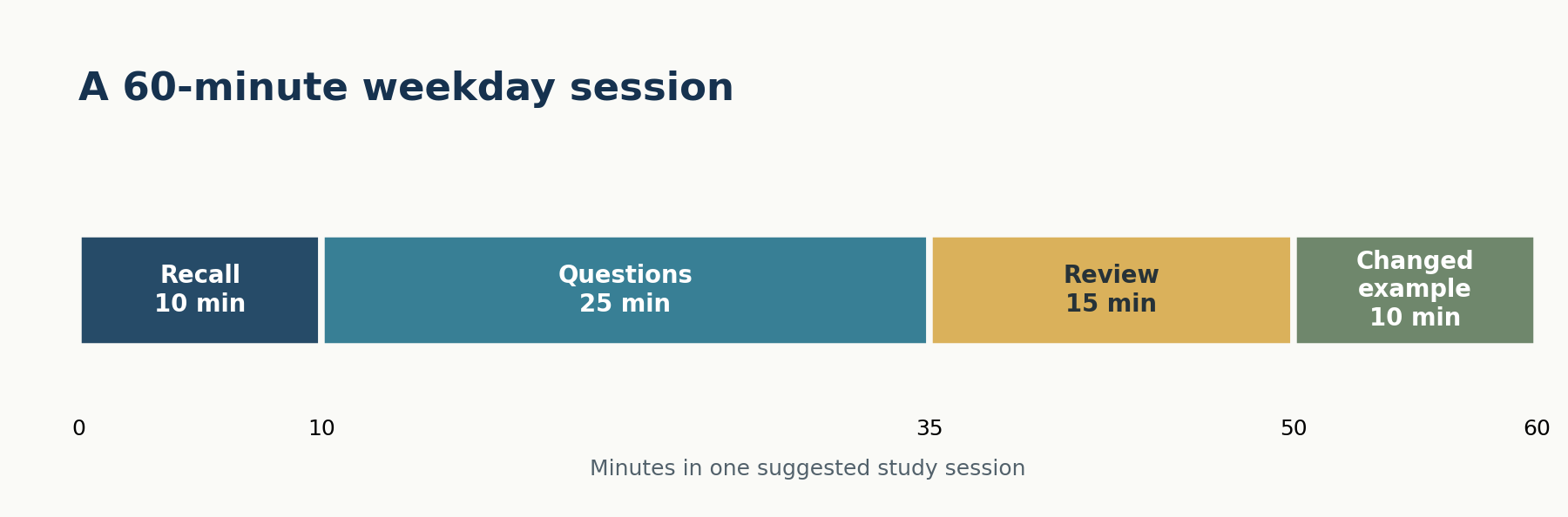
Noam's fictional timetable reserves 60 minutes on each weekday and 120 minutes on each weekend day. That provides nine hours in an ordinary week. He uses a weekday hour for ten minutes of recall, twenty-five minutes of questions, fifteen minutes of reviewing answers and ten minutes of a changed example. The division can shift when a difficult explanation needs longer.
One possible 60-minute session. The time allocation is the article's proposed routine.
After a tiring shift, he completes a shorter session with a defined result: two explained problems and one corrected mistake. He records the unfinished task for a specific later session. A missed evening changes the calendar, so he chooses which activity to move rather than adding every missed task to the following night.
For a full simulation, he arranges a longer appointment and adjusts the weekend budget beforehand. He also protects a separate review period. This distinguishes the time needed to attempt the paper from the time needed to learn from it. The ordinary nine-hour week is a planning example, and his simulation week will have a different allocation.
Days 22 to 26 rehearse the examination
Complete a simulation using the current examination duration and permitted conditions. Prepare the materials allowed by the official instructions, remove interruptions and record your finishing time. Keep uncertain answers identifiable in your private review record. Your purpose is to observe how your knowledge and decision-making behave across the full session.
Analyse the paper before selecting the next exercise. Separate errors caused by missing knowledge, an incorrect model, arithmetic, interpretation or time use. Examine correct answers that involved guessing as well. A high score can still leave a recurring gap that deserves attention, while a lower score may reveal a small set of specific problems you can address.
Imagine that Noam records 36 correct answers in one simulation and 42 in the next. He inspects the six additional correct answers individually. If four came from corrected unit handling and two were guesses, those improvements need different follow-up tasks. The corrected calculations need testing with fresh numbers; the guessed items need explanations and further practice. His record separates a higher total from the specific skills that produced it, so he can decide what to study next.
The current official format gives each question two points. Forty correct answers therefore reach 80 points. [1] Use the calculation to understand the marking, then examine where your errors cluster. Do not interpret one practice score as assurance of passing. A different set may expose different weaknesses, particularly when your method depends on recognising familiar wording.
Choose the next simulation or mixed set after reviewing those weaknesses. Compare the results by topic and error type, not only total score. Keep your timing record too. If a calculation repeatedly consumes too much time, inspect the steps that cause delay and practise a clearer method before repeating another complete paper.
Days 27 to 30 consolidate and prepare
Create a short review sheet from your recurring errors. Include the distinctions you still need to check, the relevant source references and a few examples you can explain without looking. Test the sheet by closing it and reconstructing the reasoning. Remove material you already handle consistently so that the remaining entries receive attention.
Read the examination invitation again and confirm the location, arrival arrangements and required identification. The official service distinguishes eligibility approval from registration confirmation. [1] Check that the confirmation applies to the intended sitting and retain the instructions you need for attendance. Resolve administrative uncertainty before the day you intend to travel.
Use the final sessions for selected review and familiar practice. Decide the day's task before opening the question bank, and stop when that task is complete. At the end of the month, your calendar should leave a traceable record: the difficulties you identified, the corrections you tested and the questions you can now explain independently.
רוצים לתרגל את הנושא?
אחרי הקריאה אפשר לעבור למבחן או למדריך הקשור לנושא.