
Begin with the quantity you need
Write the required result in words. “Find the current drawn by this resistive heater” is better than “use the electrical formula.” It identifies the equipment model and the output unit. Next, list the available inputs with their units. Leave a visible space for missing information rather than silently filling it from memory.
Consider a fictional resistive element connected across 230 volts with a resistance of 46 ohms at the stated operating condition. Ohm's law gives current as voltage divided by resistance: I = V/R. Therefore, I = 230/46 = 5 amperes. The relationship applies to the resistive model being considered. It does not describe every electronic load as a fixed resistance. [3]
For this example, electrical power is P = VI = 230 × 5 = 1,150 watts. The equivalent expressions I²R and V²/R give the same answer: 25 × 46 = 1,150, and 52,900/46 = 1,150. Checking an answer through another valid expression can reveal a transcription error without requiring another calculator.
Suppose somebody obtains 0.2 amperes by dividing resistance by voltage. The units expose the mistake. Ohms divided by volts do not give amperes. Numerical plausibility also helps: a heater taking only a fraction of an ampere would not match the calculated kilowatt scale. Use both checks, because a plausible number can still be wrong.
Convert units before substitution
Unit conversion deserves its own line. One kilowatt equals 1,000 watts, one milliampere equals 0.001 ampere, and one kilovolt equals 1,000 volts. Mixing prefixes inside an otherwise correct formula can change the result by a factor of a thousand. A tidy equation cannot rescue inconsistent inputs.
A fictional appliance has an electrical input rating of 1.61 kilowatts on a 230 volt supply. Under an assumed unity power factor, convert the rating to 1,610 watts and calculate 1,610/230 = 7 amperes. Writing 1.61/230 gives 0.007, which would only become meaningful if the result were deliberately expressed in kiloamperes. Most learners did not intend that conversion.
Keep the precision appropriate to the inputs. A calculation based on a rounded equipment rating should not finish with ten decimal places. Retain enough digits during intermediate work, then report a sensible result. In an examination, follow the question's rounding instruction. In a technical record, distinguish a calculated estimate from a measurement and include the conditions that support it.
Separate power from energy
Power and energy answer different questions. A 1.5 kilowatt load running continuously for 2.4 hours uses 3.6 kilowatt hours of electrical energy under those assumptions. Multiply power by time: E = Pt. The result is an energy quantity, not a larger power rating. The load remains a 1.5 kilowatt load throughout that simplified example.
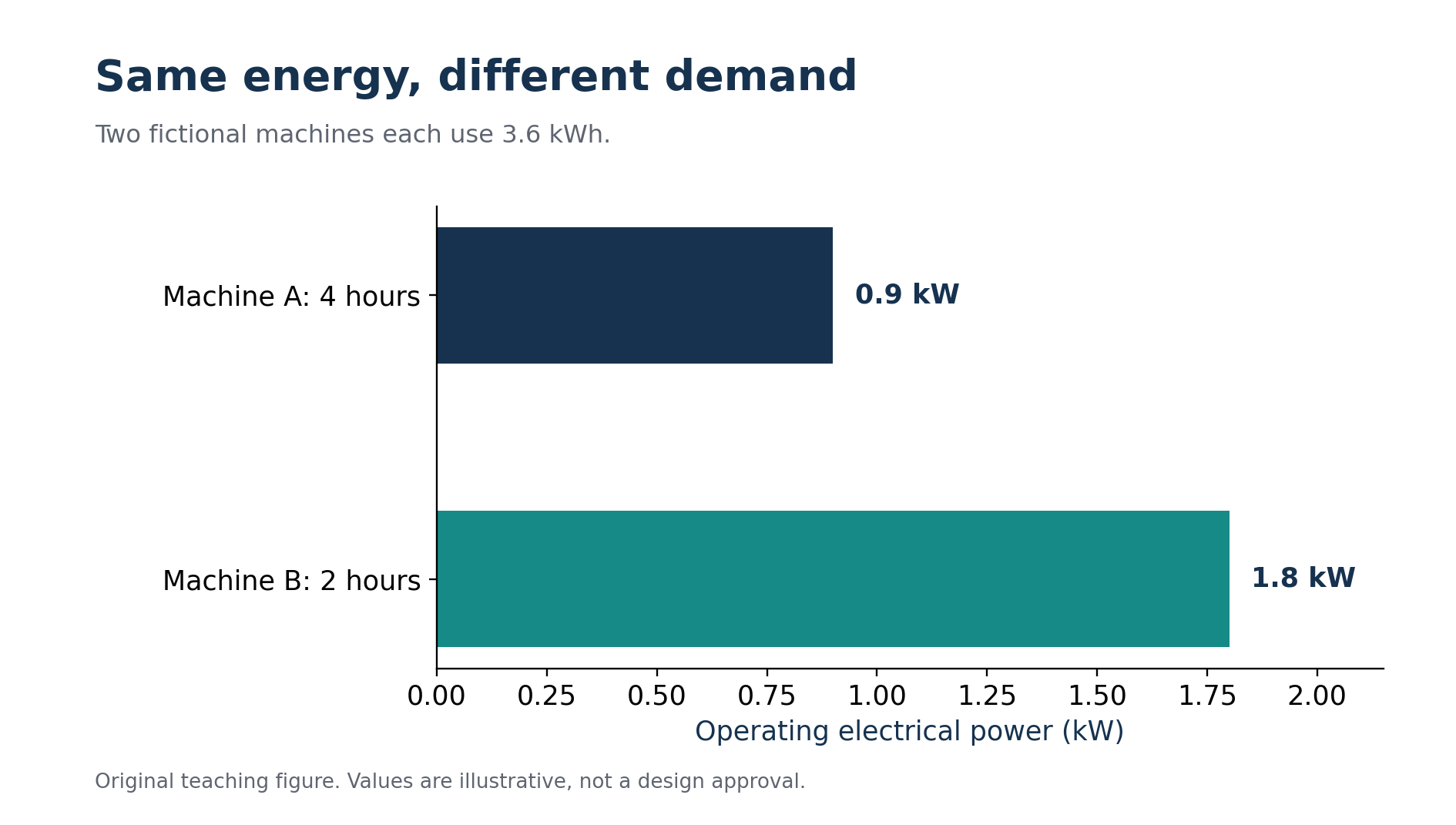
Compare two fictional operating patterns. Machine A takes 0.9 kilowatts for four hours, while machine B takes 1.8 kilowatts for two hours. Both use 3.6 kilowatt hours. Machine B nevertheless imposes twice the operating power during its running period. Equal daily energy does not imply equal instantaneous current, equal circuit demand or equal starting behaviour.
Real equipment may cycle, idle or vary its output. A nameplate multiplied by elapsed time can therefore overstate or understate actual consumption. If a heater operates at its rated power for only half a three hour period, its simplified energy estimate uses 1.5 hours of active operation. Explain the assumed duty cycle rather than hiding it inside the arithmetic.
For an energy comparison, record operating time alongside power. For a circuit comparison, record the simultaneous demand and relevant load behaviour. These separate records prevent a common planning mistake: choosing supply capacity from a monthly energy total. A workshop can use relatively little energy overall while still demanding a substantial current during a short production period.
Understand what power factor changes
In a single phase alternating current circuit, apparent power is the product of RMS voltage and RMS current. Power factor is active power divided by apparent power. It connects the useful active power figure to the current needed to supply it. For distorted waveforms, true power factor should not automatically be replaced by the cosine of a phase angle. [4]
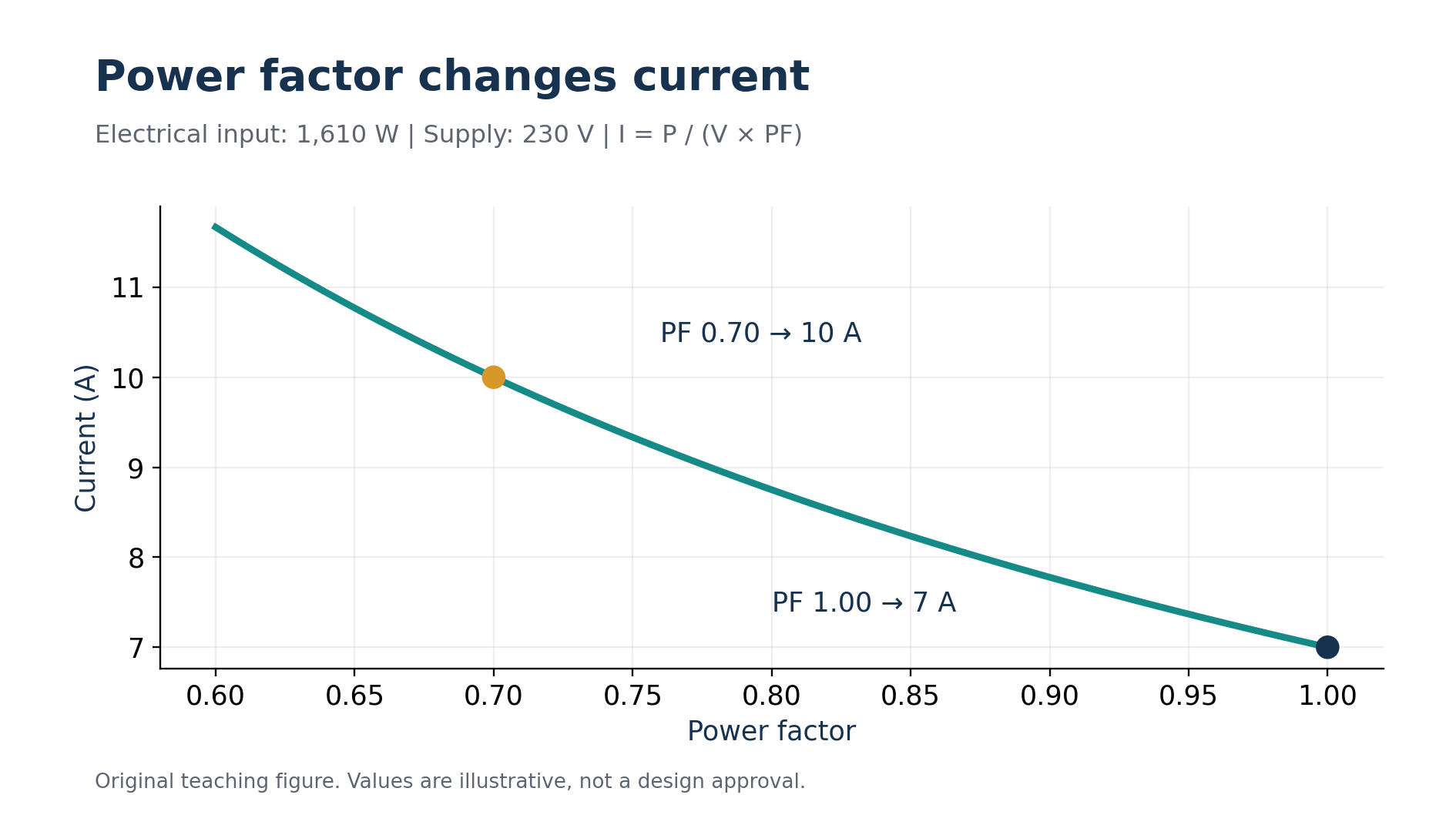
Take a fictional single phase load with 1,610 watts of electrical input, 230 volts and a stated power factor of 0.7. Its apparent power is 1,610/0.7 = 2,300 volt amperes. The current is 2,300/230 = 10 amperes. Ignoring the power factor would produce 7 amperes and understate the current in this example.
That difference is a modelling issue, not a difficult division. Before calculating, ask whether the power figure is active power, apparent power or output power. If a question supplies kilovolt amperes, the conversion to current differs from a question supplying kilowatts. If power factor is absent, state the assumption or identify the missing input rather than presenting an unsupported precise answer.
Current rises as power factor falls for the stated 1,610 watt, 230 volt teaching load. Original chart.
Use the correct three phase relationship
For a balanced three phase load, total active power can be written as P = √3 × U × I × PF, using line to line voltage and line current. With sinusoidal quantities, PF can be expressed as cos φ. The balanced model and the voltage definition matter. Substituting a phase to neutral voltage into this expression changes the problem. [5]
Assume a fictional balanced load takes 9,000 watts at 400 volts line to line with a power factor of 0.9. Rearranging gives I = 9,000/(√3 × 400 × 0.9), approximately 14.4 amperes. This is the line current under the assumptions. It is not 14.4 amperes divided among three phases, and it is not three separate currents to add into one conductor.
An independent check starts with apparent power: 9,000/0.9 = 10,000 volt amperes. Dividing that by √3 × 400 produces the same current. If the two routes disagree, inspect the voltage definition, the conversion from kilowatts and the power factor. Those are more likely error locations than the square root itself.
An unbalanced installation needs a different analysis. Three unequal single phase loads connected across different phases cannot be represented accurately just by inserting their combined watts into a balanced formula. Phase allocation, individual currents and neutral behaviour require attention. A summary total may remain useful for an inventory, but it does not prove that each conductor experiences the same loading.
Read motor ratings without guessing
A motor's mechanical output power is not automatically its electrical input power. In a simplified example, a motor delivering 4 kilowatts with an assumed efficiency of 0.8 requires 5 kilowatts of electrical input. Efficiency compares output with input. Power factor then relates that electrical active input to apparent power. The two factors describe different relationships.
If this fictional motor uses a balanced 400 volt three phase supply and has a power factor of 0.85, its running current estimate is 5,000/(√3 × 400 × 0.85), approximately 8.49 amperes. Treat this as an exercise with supplied values. Actual design should use the relevant manufacturer data, operating conditions and required starting assessment.
Do not apply efficiency twice. When a question already gives electrical input power, dividing by efficiency again invents an additional load. Equally, do not assume every printed kilowatt rating means input. Write a short annotation beside the number: “electrical input” or “mechanical output.” That annotation can prevent an error more effectively than memorising another formula.
Starting current is another separate question. A running current calculation alone does not establish the maximum transient demand, voltage dip or appropriate protective characteristic. For examination practice, answer the quantity actually requested. For a real equipment schedule, leave a dedicated field for starting information so it cannot disappear behind the running power total.
Build a load schedule that can be reviewed
Create a fictional inventory with a 1,150 watt heater, a 1,610 watt appliance and the 5,000 watt motor input calculated above. The connected active power is 7,760 watts. That sum describes the inventory under the stated ratings. It does not by itself determine the supply current because the loads use different supply arrangements and power factors.
For each item, record its supply, input rating, operating current, power factor where relevant, operating pattern and phase allocation. Then describe which equipment can operate together. A heater used only during cleaning may not coincide with production equipment, but that claim needs an operational basis. A demand allowance should be explained and supported, not selected because it makes the final number convenient.
Add an uncertainty column. An unreadable nameplate, an unknown operating cycle or an unspecified future machine should remain visible. Asking for missing data is part of completing a useful calculation. False precision makes a schedule look finished while leaving its most important assumptions unresolved.
Finally, separate the calculation from the selection. A current estimate becomes an input to cable sizing and protective coordination. It does not automatically prescribe a conductor cross section or breaker rating. Keeping those stages distinct makes the work easier to audit and helps a learner explain exactly what has, and has not, been established.
Practise explaining the answer
Use three short statements when presenting a calculation. First, describe the model: “This is a balanced three phase electrical input load.” Second, identify the quantities and units. Third, give the result with its assumption and a brief reasonableness check. This structure works for a written solution, an oral examination answer and a handover note.
Try a fresh exercise without copying a previous substitution. A resistive device has 690 watts of input at 230 volts. Its current is 3 amperes. If it runs continuously for 80 minutes, its energy use is 0.92 kilowatt hours, because 80 minutes equals four thirds of an hour. The two answers describe different aspects of the same device.
Now change the question: keep 690 watts and 230 volts, but specify a power factor of 0.75 for a different single phase load. Current becomes 4 amperes. Explain why the wattage did not change while current did. A correct explanation shows understanding beyond arithmetic and helps reveal whether you have confused active power with apparent power.
A final useful exercise is to audit somebody else's solution. Suppose the working shows a correct formula and a believable answer, but the original rating was copied from a photograph without its unit. Ask for the photograph and trace the number back to its source. Then ask whether the supplied voltage describes the same connection used in the equation. Reviewing the evidence behind each input is often more valuable than repeating the division. This also creates a practical revision habit: when a result changes, record which input changed and why, so the next reviewer can reconstruct the decision without guessing your earlier intentions.
Good electrical calculation is a sequence of justified choices. Identify the quantity, establish the model, normalise the units, calculate accurately and check the final result. With that sequence, a calculator becomes a useful assistant instead of an authority whose output must be accepted without explanation.
מקורות והפניות
המקורות המוזכרים בגוף המאמר מופיעים כאן כפי שנמסרו במקור.
- [1] Ovrim Rishui: electricity basics and Ohm’s law
- [2] Nami Academy: tools collection
- [3] OpenStax College Physics 2e: Ohm’s law, resistance and simple circuits
- [4] Schneider Electric: definition of power factor
- [5] Schneider Electric: definition of reactive power
רוצים לתרגל את הנושא?
אחרי הקריאה אפשר לעבור למבחן או למדריך הקשור לנושא.